Wildfire & Smoke Intrusion
Fire & Smoke Assessment
Wildfire Smoke as a Property Damage Event
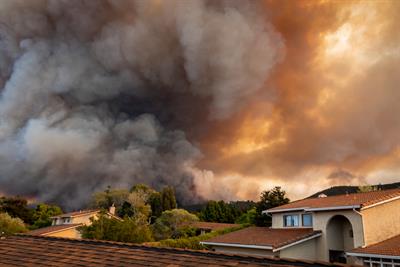
Wildfire smoke intrusion is a growing and frequently misunderstood category of commercial property loss. Properties that are never touched by flames may sustain significant contamination from wildfire smoke infiltrating through HVAC systems, building openings, and the building envelope during nearby wildfire events. The smoke produced by wildfires contains a complex mixture of fine particulates (PM2.5), volatile organic compounds, polycyclic aromatic hydrocarbons, and combustion gases — many of which are known or suspected carcinogens.
These contaminants deposit on interior surfaces, embed in porous materials, and persist in HVAC systems long after the smoke event has passed. Unlike a direct-fire event where the origin and scope are obvious, wildfire smoke intrusion is diffuse, often invisible, and typically affects large commercial buildings uniformly — making systematic investigation essential for documenting the true scope of contamination.
Why Wildfire Smoke Claims Are Disputed
Wildfire smoke intrusion claims are among the most frequently disputed in commercial property insurance, for several reasons:
Causation questions: Carriers often question whether detected contamination is from the specific wildfire event or from pre-existing background conditions. CDS documentation addresses this by characterizing the specific chemical fingerprint of wildfire smoke and documenting its presence in concentrations consistent with an acute smoke intrusion event.
Scope disputes: Without systematic investigation, the extent of contamination is difficult to establish. CDS provides floor-by-floor, area-by-area documentation of contamination levels that supports a defensible scope.
Damage threshold disputes: Carriers may argue that detected contamination levels do not rise to the level of actionable damage. CDS reports reference applicable standards and guidelines for occupant exposure and remediation thresholds, establishing whether detected levels require remediation.
The CDS Wildfire Smoke Investigation Process
Our wildfire smoke intrusion investigations are designed to produce documentation that withstands scrutiny in appraisal, mediation, and litigation contexts:
Pre-Investigation Review: We review HVAC system plans, building operations records, and available air quality data from the event period to establish context for the investigation.
Indoor Air Quality Testing: Air sampling for VOCs, fine particulates (PM2.5/PM10), PAHs, and combustion gases establishes current indoor air conditions and documents contamination levels.
Surface Wipe Sampling: Surface samples from representative locations throughout the building characterize soot and combustion by-product deposition on interior surfaces.
HVAC System Assessment: Inspection and sampling of air handling units, ductwork, filters, and coils to document system contamination and inform remediation scope.
Remediation Protocol Development: A science-based remediation protocol specifying cleaning methods, material replacement thresholds, and clearance criteria for each affected system and space type.
Health Implications and Occupant Safety
Wildfire smoke contamination in commercial buildings is not merely a cosmetic or odor issue. Fine particulates and VOCs embedded in building materials, furnishings, and HVAC components continue to off-gas and re-entrain in air long after the visible smoke event has passed. For commercial properties with employee and public occupancy obligations — offices, healthcare facilities, schools, hotels — returning to occupancy without adequate remediation creates ongoing health exposure and potential liability.
CDS reports provide the occupant safety context that property owners and their advisors need to make informed decisions about remediation scope and reoccupancy timing.
Contact CDS for Wildfire Smoke Assessment
CDS deploys nationally for wildfire smoke intrusion investigations. Whether your property is adjacent to an active fire zone or experienced smoke infiltration from a regional wildfire event, our industrial hygiene team provides the objective, science-based documentation your claim requires. Contact us at (303) 242-6361.