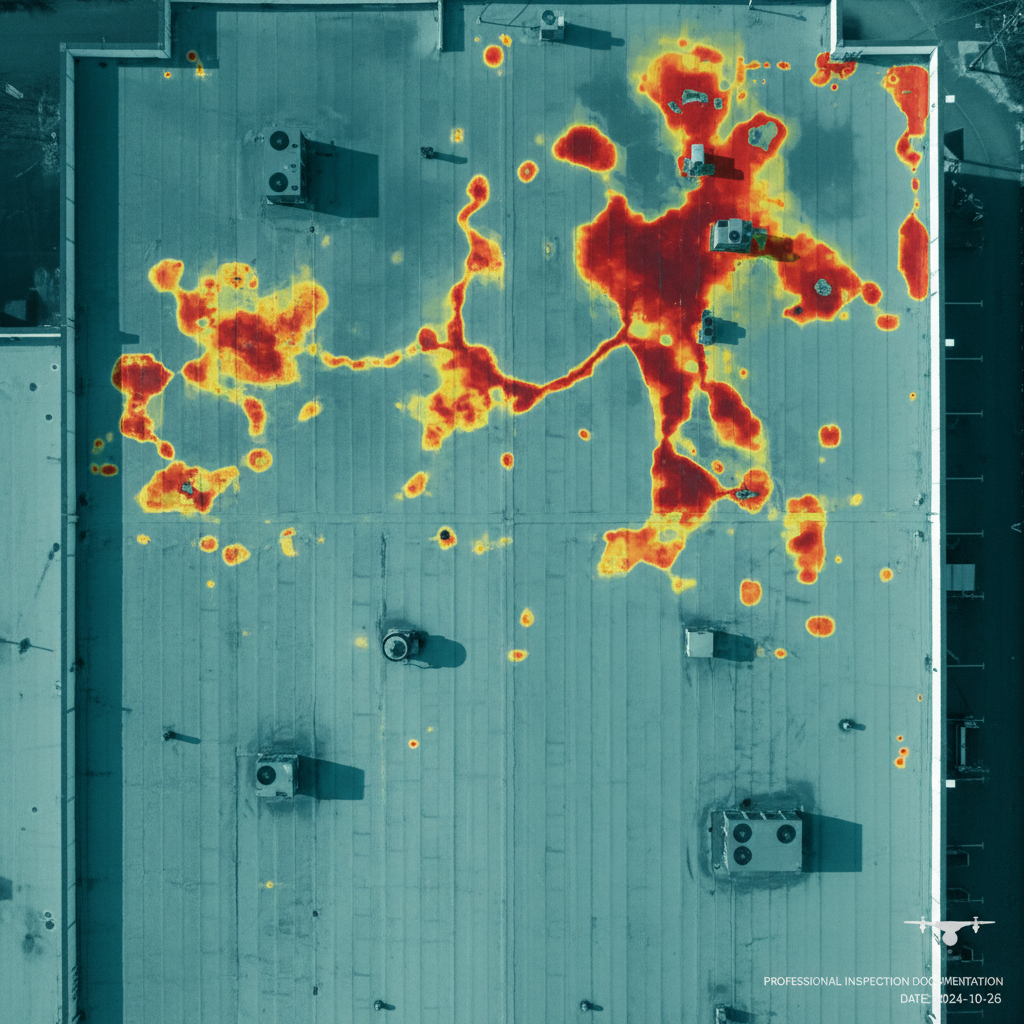
Thermal Moisture Investigation
Aerial Drone Surveys
The Science of Thermal Roof Moisture Detection
Thermal roof moisture investigation is based on a well-established principle of building physics: wet insulation within a roofing assembly retains heat differently than dry insulation. During the day, all roofing materials — wet and dry — absorb solar radiation and increase in temperature. As the sun sets and ambient temperatures drop, dry insulation cools rapidly, but moisture-saturated insulation releases its stored heat more slowly, creating a detectable temperature differential at the roof surface.
This thermal anomaly — wet insulation appearing warmer than surrounding dry areas during the post-sunset cooling period — is detectable by radiometric thermal cameras mounted on drones. The optimal survey window is typically one to two hours after sunset on a day with sufficient solar loading. During this window, moisture-affected areas of a roofing assembly show as clearly warmer zones against the cooling background, allowing investigators to map moisture distribution across the entire roof surface.
Why Drone-Based Thermal Surveys Are Superior
Thermal roof surveys have been conducted for decades using infrared cameras carried by investigators on the roof surface. While effective, ground-based thermal surveys have significant limitations that drone-based surveys overcome:
Coverage and Efficiency: A ground-based investigator with a handheld thermal camera can survey perhaps 20,000–30,000 sq ft of roof surface in an evening. A drone-based survey covers 100,000 sq ft or more in the same timeframe, making comprehensive survey of large commercial roofs economically practical.
Repeatability and Documentation: Drone thermal surveys produce a continuous georeferenced data set that can be precisely analyzed and presented. Ground-based surveys produce a collection of individual thermal images that are difficult to assemble into a comprehensive roof map.
Safety: Conducting a thorough roof investigation in low-light post-sunset conditions on a wet or damaged roof surface carries significant safety risks for investigators. Drone-based surveys eliminate those risks entirely.
Defensibility: The georeferenced orthomosaic thermal data set produced by our drone surveys — showing moisture extent mapped precisely to GPS coordinates — is significantly more defensible in carrier negotiations and appraisal proceedings than hand-drawn diagrams based on ground-level handheld scans.
Tramex DEC Validation: The Ground-Truth Confirmation
Thermal imaging identifies moisture anomalies based on temperature differentials — it is an inferential technology, not a direct measurement. While highly reliable under proper conditions, thermal imaging results are considered most defensible when corroborated by a second, independent measurement method.
CDS combines drone thermal surveys with Tramex DEC surface scanning — a non-destructive radio frequency technology that directly measures moisture content in roofing assemblies from the surface without coring or probing. Our investigators use the drone thermal data to identify anomaly areas, then deploy the Tramex DEC scanner to confirm and quantify moisture at those locations. The result is a dual-method, corroborated data set that has withstood carrier challenges in numerous appraisal and litigation contexts.
Applications for Insurance Claims
Thermal moisture investigations serve multiple roles in large commercial roofing claims:
Establishing Damage Extent: In storm damage claims where roof membrane damage has allowed water into the roofing assembly, thermal surveys document the full moisture-affected area — which is almost always larger than what is evident from visible damage assessment alone.
Establishing Causation Timeline: In claims where the date of damage is disputed, thermal moisture mapping combined with historical weather data and available pre-loss roof inspection records can help establish whether moisture intrusion is consistent with the claimed event.
Scope Development: Precise thermal moisture mapping enables accurate square footage calculations for insulation replacement and membrane repair scope — avoiding both under-scoped remediation and over-scoped claims.
Schedule a Thermal Moisture Survey
CDS thermal drone surveys are available nationwide. Contact us at (303) 242-6361 to discuss your roofing investigation needs.