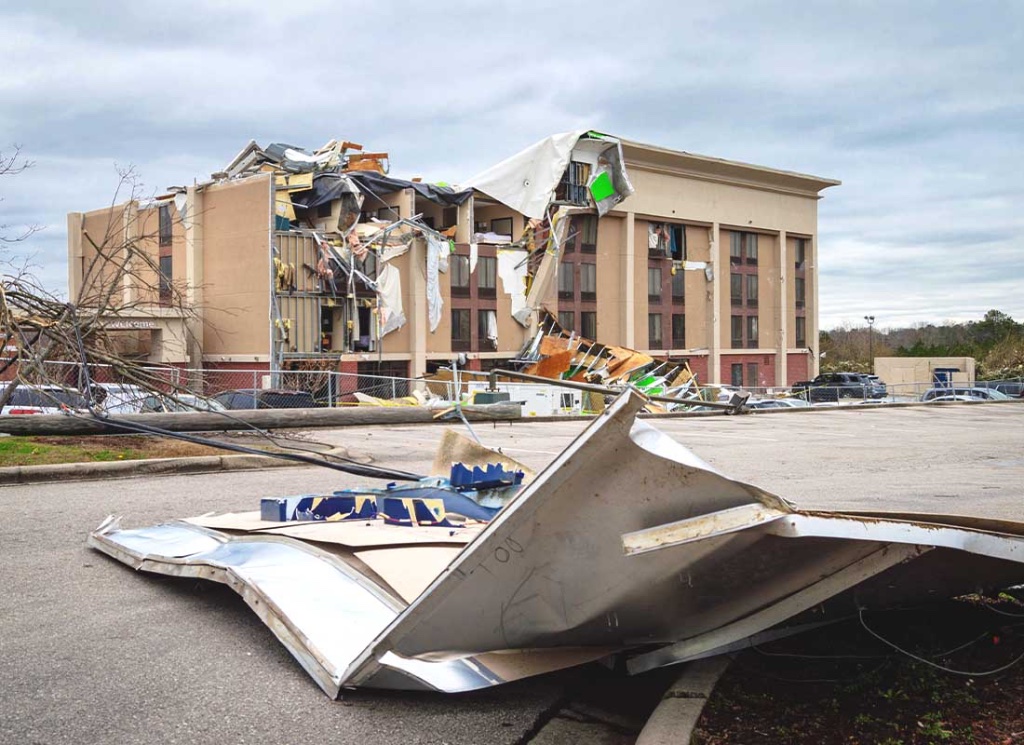
Hurricane & Storm Damage
Moisture Mapping & Investigation
What Happens to a Commercial Building During a Hurricane
Hurricanes and tropical storms subject commercial structures to forces far beyond ordinary weather events. Wind-driven rain penetrates envelope systems at pressures that can push water through window seals, roof flashings, wall cladding joints, and mechanical penetrations that would otherwise remain watertight. Storm surge and flooding introduce standing water into below-grade spaces, elevator pits, and mechanical rooms. Roof membranes are punctured or displaced, allowing water to enter roofing assemblies and migrate laterally beneath waterproofing layers — sometimes traveling dozens of feet from the point of entry before appearing on interior surfaces.
The resulting moisture distribution is rarely intuitive. A building that looks structurally sound from the outside may harbor significant water intrusion in wall cavities, ceiling assemblies, floor systems, and insulation layers. Left undetected, this moisture creates ideal conditions for mold colonization within 24–72 hours of saturation.
Why Standard Visual Inspection Is Not Enough
After a major storm, adjusters and property owners often rely on visible damage — stained ceilings, buckled flooring, and wet walls — to scope the loss. This approach consistently misses the majority of moisture-affected areas. Studies in building science consistently show that thermal imaging reveals two to four times the affected area compared to visual inspection alone.
Water intrusion during hurricane events migrates through concealed pathways: behind exterior cladding, through insulation cavities, along structural members, and down interior wall assemblies. By the time moisture becomes visible at the surface, it has often saturated insulation, sheathing, and structural components well beyond the visible boundary. Documenting only the visible damage results in a scope that will not achieve a dry building — and will lead to mold growth and secondary damage after restoration is presumed complete.
How CDS Investigates Hurricane Moisture Damage
Claims Documentation Solutions deploys rapidly following storm events to ensure documentation begins before conditions change. Our investigators use a multi-tool approach:
Infrared Thermography (FLIR): Certified Level II thermographers scan all affected surfaces — walls, ceilings, floors, and roofing assemblies — to identify temperature anomalies indicating moisture presence behind finished surfaces. This is the most powerful tool for revealing the true extent of water migration.
Moisture Meter Readings: Pin-type and non-invasive moisture meters confirm and quantify moisture levels detected by thermal imaging, providing numerical readings for all affected materials.
Floor Plan Moisture Diagrams: All moisture-affected areas are plotted on floor plans, providing a spatial record of water migration patterns throughout the structure.
Photographic Documentation: Every finding is documented with date-stamped photography, thermal images, and annotated diagrams.
Comprehensive Written Report: A full narrative report details the findings, methodology, affected materials, and recommended scope of remediation — formatted for use by adjusters, carriers, and remediation contractors.
The Risk of Delayed or Incomplete Documentation
Time is the critical variable in hurricane moisture claims. Mold growth begins within 24–72 hours of saturation and advances rapidly in the warm, humid conditions that follow storm events. Secondary damage — structural deterioration, content loss, and mold remediation costs — can exceed the original water intrusion damage if moisture is not fully identified and dried promptly.
Incomplete documentation creates a second category of risk: claims disputes. When carriers and insureds disagree on the extent of damage, incomplete initial documentation leaves the property owner unable to demonstrate the full scope. CDS provides defensible, science-based documentation from the outset — ensuring the claim reflects the true damage, not just what was visible.
How CDS Can Help Your Claim
CDS maintains deployment capacity for rapid response following catastrophic storm events. Our teams are experienced in large-loss hurricane documentation across commercial, industrial, healthcare, educational, and municipal properties. We work directly with property owners, public adjusters, attorneys, and carriers to provide objective, third-party documentation that supports accurate claim valuation.
Contact our emergency line at (303) 242-6361 to initiate deployment following a hurricane or tropical storm event. We deploy nationwide.